

Academic Medical Center
Comprehensive Nephrology & Transplant
Joint CommissionMagnet RecognitionUNOS Transplant Center
✓ 24/7 ER✓ ICU✓ Insurance
Nephropexy is a surgical procedure that repositions and fixes a mobile, "floating" kidney back in its normal place in the upper abdomen, so it no longer drops down when you stand. It's used to treat nephroptosis when the kidney's movement is causing pain, urinary problems, or kidney damage.

Symptomatic nephroptosis — a kidney that drops more than two vertebral bodies, or about 5 cm, when moving from lying to standing — causing positional flank pain, recurrent urinary infections, hydronephrosis, or a Dietl's crisis that hasn't improved with a supportive lumbar belt or physical therapy.
Bleeding, infection, injury to nearby organs or blood vessels, and the kidney remaining mobile after surgery. Risks are minimised by careful patient selection and experienced surgical teams.
Standard blood work, upright imaging (ultrasound, Doppler and intravenous pyelography) to confirm the diagnosis, anaesthesia consultation, and fasting per protocol.
Scheduled clinic visits at 1, 4 and 12 weeks, with follow-up upright imaging to confirm the kidney has stayed in position, alongside longer-term monitoring for recurrence.
Nephropexy is the surgical intervention that repositions and fixes a floating or mobile kidney in place, done to prevent it from descending (nephroptosis) or, less commonly, to deliberately reposition a kidney to compensate for a shortened ureter. The procedure was first performed in 1881, and while it originally used a large open incision, minimally invasive laparoscopic nephropexy is now the standard approach.
In plain terms: your surgeon anchors the outer layer of the kidney (the renal capsule) to the muscle behind it — usually the psoas muscle — using stitches, and sometimes a soft surgical mesh, so the kidney can no longer slide down when you stand.
Nephropexy is only considered when nephroptosis is causing symptoms — an incidental finding on a scan isn’t, by itself, a reason for surgery. Symptoms a urologist looks for include:
These are the conditions linked to this treatment in the directory. Your clinician decides whether treatment is appropriate using your symptoms, examination and test results.
Remember: These entries are not a diagnosis or a treatment recommendation. Discuss your symptoms and test results with a qualified clinician.
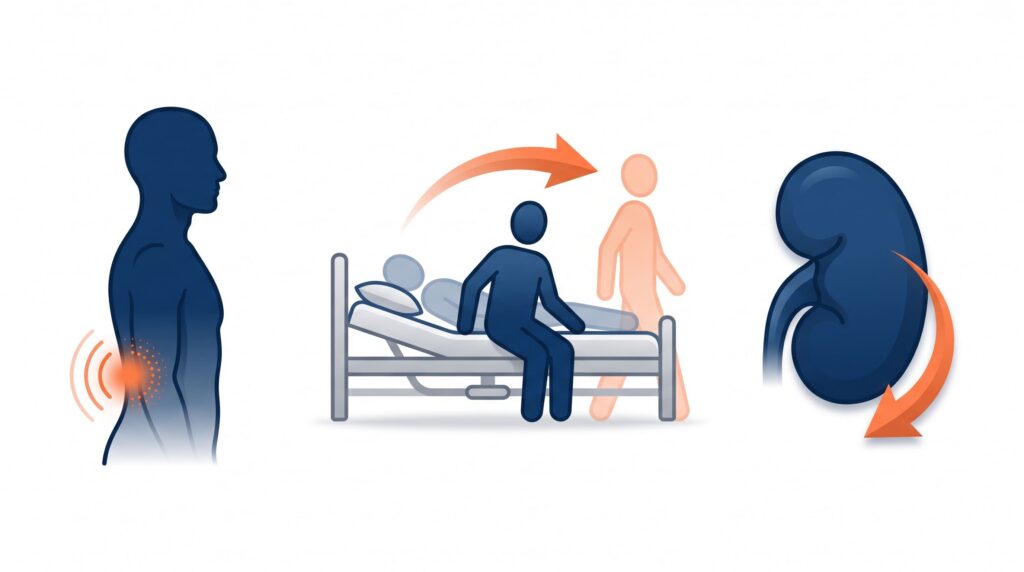
If you notice pain in your side or lower back that consistently shows up when you’re upright and eases when you lie down, it’s worth getting checked — this pattern is easy to miss on a standard scan, because imaging is usually done lying down. In most cases a floating kidney causes no problems at all, and simple steps like a supportive belt or physiotherapy are often tried first, so there’s no need to panic. A urologist can confirm what’s going on with the right imaging and talk you through whether any treatment, including nephropexy, is actually needed. Use the „Find a specialist” link to connect with a verified urologist and get a clear answer.
Before surgery, your urologist confirms the diagnosis and rules out other causes of flank pain. This typically involves an ultrasound scan to see the kidney’s position, a Doppler scan to check blood flow, and intravenous pyelography (IVP) to image the kidney while standing, since lying-down scans can look completely normal. You’ll also be asked about smoking and general health, since quitting beforehand can support a faster recovery.
On the day of surgery, nephropexy is done under general anaesthetic. There are several surgical approaches, and your urologist will recommend the one that fits your anatomy and symptoms:
Whichever approach is used, the kidney’s capsule or surrounding fascia is secured high in the retroperitoneum, typically to the psoas or quadratus lumborum muscle, using non-absorbable sutures and sometimes surgical mesh.
For people whose symptoms are genuinely linked to a mobile kidney, nephropexy aims to settle the pain and functional problems the movement is causing, usually through a minimally invasive approach.
The treatment has risks and trade-offs to discuss with your care team. The information below comes from this treatment’s data: bleeding, infection, and vascular access or wound-site issues. Risks are minimised by careful patient selection and experienced surgical teams.
Who it may not suit: these are general cautions, not a personal verdict. A qualified clinician must assess your full medical picture before recommending or delaying treatment.

Immediately after surgery, you’ll be monitored in a recovery area as the anaesthetic wears off. In one case series using the percutaneous technique, the average postoperative hospital stay was two days; laparoscopic and robotic approaches often involve a similarly short stay of one to a few days, while open surgery typically requires a longer admission. Pain in the first days after surgery is normal and is managed with medication; in one series, patients needed opioid pain relief for less than a day after a retroperitoneoscopic approach.
Follow-up imaging (often an upright ultrasound or urogram) may be used to confirm the kidney is staying in position.
Most people recover without issue, but it’s worth knowing what to watch for so you can get help quickly if something isn’t right. Tell your care team promptly if you notice:
These can be signs of infection, bleeding, or a problem with kidney drainage and should be assessed quickly rather than waited out.
New or severe symptoms require prompt medical advice. Do not wait for a routine appointment if you feel seriously unwell.
Recovery after nephropexy is generally quicker when a minimally invasive technique is used, though it still takes a few weeks to feel fully back to normal.
Verified kidney centres linked to this treatment in the KidneyGlobal directory.



Usually not. It's common but, in most cases, completely asymptomatic and often found incidentally on imaging done for another reason. Only a minority of people develop symptoms serious enough to need treatment.
Not necessarily. Nephropexy is only recommended when nephroptosis is causing symptoms — pain, infections, or kidney swelling. Many people are managed first with a supportive belt or physiotherapy.
A urologist — it's a structural, anatomical procedure on the kidney's position, not a kidney-function (nephrology) treatment.
No — nephropexy is done under general anaesthetic, so you're asleep throughout.
Today it's most often done laparoscopically (keyhole) or robotically. Open surgery is reserved for specific, usually complex, cases.
Reported symptom-relief rates vary across small published case series, generally in the range of roughly 80–90%, but results depend heavily on patient selection, technique and surgeon experience — ask your urologist about outcomes at your specific centre.