Extracorporeal shock wave lithotripsy (ESWL)
Extracorporeal shock wave lithotripsy (ESWL) uses focused shock waves from outside your body to break a kidney or ureter stone into smaller pieces so you can pass them naturally in your urine — no incision, no scope, and usually done as a same-day outpatient procedure.

Briefly about this treatment
Indications
Kidney or ureter stones that are causing pain, blocking urine flow, or unlikely to pass on their own because of their size or position — typically ureteric stones under 10 mm and many kidney stones in the 5–20 mm range.
Risks
Bruising, blood in the urine, and a small chance of infection or a fragment blockage. Risks are minimised by careful patient selection and experienced teams.
Pre-procedure
Imaging (X-ray, ultrasound or CT) to locate and size the stone, blood and urine tests to check for infection or bleeding risk, and a review of your current medications, especially blood thinners.
Follow-up
A follow-up visit with imaging a few weeks after treatment to check how much of the stone has cleared, removal of a temporary stent if one was placed, and guidance on preventing another stone.
What is Extracorporeal shock wave lithotripsy (ESWL)? An expert explains
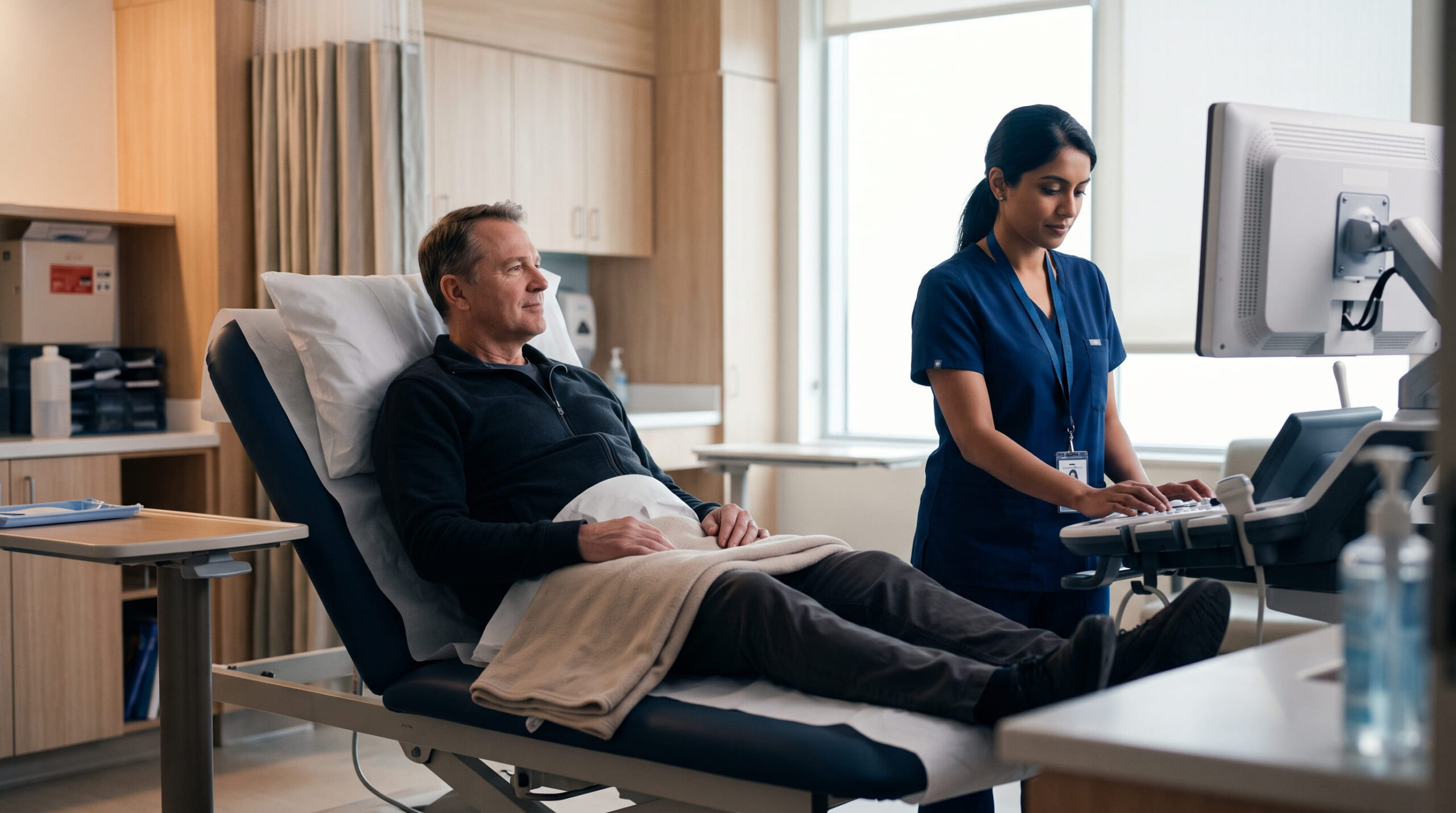
ESWL uses a device called a lithotripter, which generates short pulses of high-energy pressure waves. Your care team uses X-ray or ultrasound imaging to find the stone precisely, then aims thousands of these shock waves at it from outside your body. As the waves pass harmlessly through skin and soft tissue, they concentrate their energy at the stone, causing it to crack and eventually crumble into sand-like fragments small enough to travel down and out through your urine. It is the most common kidney stone treatment used in the U.S. and has been used worldwide since the early 1980s, remaining a first-line option for suitably sized, suitably located stones.
Understanding the words helps: extra-corporeal = outside the body; litho = stone; tripsy = crushing. Put together, it simply means „crushing a stone from outside the body.”
Signs it may be time for Extracorporeal shock wave lithotripsy (ESWL)
You might be a candidate for ESWL if you’re noticing:
- Ongoing pain in your back, side or lower abdomen that hasn’t eased with rest or pain relief
- Pain that comes in waves and spreads toward your groin
- Blood in your urine, or urine that looks pink, red, or unusually cloudy
- Difficulty passing urine, or a sense that your urine flow is blocked
- A stone that’s already shown up on an X-ray, ultrasound or CT scan, which your doctor says is unlikely to pass on its own
These symptoms alone don’t confirm a stone or that ESWL is the right treatment for it — only imaging and a clinician’s assessment can do that.
These are the conditions linked to this treatment in the directory. Your clinician decides whether ESWL is appropriate using your symptoms, examination and test results.
- Nephrolithiasis (Kidney Stones) — Hard mineral deposits in kidneys causing pain.
- Calcium Oxalate Stones — Most common type of kidney stone.
- Uric Acid Stones — Stones formed from uric acid crystals.
- Recurrent Kidney Stones — Frequent stone formation damaging nephrons.
- Struvite Stones — Stones formed due to infection with urease-producing bacteria.
Remember: These entries are not a diagnosis or a treatment recommendation. Discuss your symptoms and test results with a qualified clinician.

When to consult a specialist
If some of this sounds familiar, try not to jump to the worst-case scenario — most kidney and ureter stones are very manageable once they’re found. A simple urine test, blood test and imaging scan can usually tell your care team the size, position and likely best treatment for your stone, often within a single visit. You don’t have to work this out alone or decide on ESWL yourself — a urologist can confirm whether it’s the right option for you. Find a specialist to book a consultation with a verified urologist near you.
How a session works
- Before your session: You’ll usually have imaging (X-ray, ultrasound, or CT) to confirm the stone’s size, position, and density, and blood/urine tests to check for infection or bleeding risk.
- Positioning: You’ll lie on a treatment table, often on a water-filled or gel cushion that helps transmit the shock waves into your body.
- Pain relief: Depending on the clinic and the type of lithotripter, you may receive sedation, local anesthesia, or in some cases general anesthesia.
- Targeting: Your care team uses live X-ray or ultrasound to line the shock waves up precisely with the stone.
- Treatment: The machine delivers a series of focused shock waves — often somewhere in the range of 1,000 to a few thousand pulses — aimed at the stone. A typical session lasts about 45 minutes to an hour, though this varies.
- Stent (sometimes): For larger stones, or if there’s a risk of blockage as fragments pass, your urologist may place a small, temporary tube called a ureteral stent to help urine — and stone fragments — drain more easily.
Benefits
ESWL is popular precisely because it avoids the bigger trade-offs of surgical stone removal. For many suitably sized, suitably placed stones, it offers a genuinely lighter path back to normal life.
- No incision, and general anesthesia usually isn’t required — lower surgical risk than open or laparoscopic stone removal
- Outpatient procedure — most people go home the same day
- Shorter recovery than surgical stone removal
- Can be repeated if fragments remain, without the added risk of repeat surgery
Risks & side effects
The treatment has risks and trade-offs to discuss with your care team. The information below comes from this treatment’s data: bruising, blood in the urine, and a small chance of infection or a fragment blockage. Risks are minimised by careful patient selection and experienced teams.
Most people tolerate ESWL well, but possible risks and side effects include:
- Pain as fragments pass, sometimes requiring prescribed pain relief
- Bruising on the skin where the shock waves entered, or bruising around the kidney
- Blood in the urine for a short period after treatment
- Urinary tract infection
- Blockage if fragments get stuck in the ureter — sometimes needing a follow-up procedure to clear
- Temporary changes in blood pressure, reported in some studies though not common
Who it may not suit: ESWL is generally avoided, or used with extra caution, in people who are pregnant, have an untreated urinary tract infection, have a significant bleeding disorder or are on certain blood-thinning medication, have uncontrolled high blood pressure, have an abdominal aortic aneurysm near the treatment area, or have a body size or stone position that makes accurate targeting difficult. These are general cautions, not a personal verdict. A qualified clinician must assess your full medical picture before recommending or delaying treatment.

What happens during & after
During: You may feel a tapping or knocking sensation with each shock wave. You’ll be monitored throughout, and the team can pause or adjust if you’re uncomfortable.
Right after: Most people are monitored for one to a few hours afterward before going home the same day — ESWL is typically an outpatient procedure, with most visits lasting around two hours in total, and people generally able to resume their normal routine right away.
Over the following days to weeks: Stone fragments pass gradually in your urine. This can take anywhere from a few days to several weeks depending on stone size. You’ll likely be asked to:
- Drink plenty of water to help fragments move through
- Strain your urine through a filter/gauze so fragments can be collected and, if needed, sent for lab analysis
- Take prescribed pain relief and, sometimes, a short course of antibiotics
- Attend a follow-up appointment with imaging to check how much of the stone has cleared, and to remove a stent if one was placed
Possible complications
Less common but more serious complications can include significant bleeding around the kidney, a larger collection of blood (hematoma) requiring monitoring or treatment, and, rarely, injury to nearby organs.
- Significant bleeding around the kidney requiring monitoring or intervention
- Hematoma formation
- Rare injury to nearby organs
- Persistent blockage needing a follow-up procedure if fragments don’t clear
Your urologist will screen for risk factors beforehand and explain how likely these are in your specific case — this list is general information, not a prediction for you personally.
New or severe symptoms require prompt medical advice. Do not wait for a routine appointment if you feel seriously unwell.
Recovery
Immediately after: Mild soreness, some blood in the urine, and possible bruising are common in the first day or two.
First few days: Focus on drinking plenty of water, taking any prescribed pain relief or antibiotics as directed, and straining your urine if you’ve been asked to. Some people pass fragments within 24–48 hours; for others it takes longer.
First 1–4 weeks: Most stone fragments pass within this window, though larger stones can take longer. Mild, intermittent discomfort as fragments move is common; sudden severe pain, fever, or an inability to urinate is not — contact your care team if these occur.
Follow-up visit: You’ll typically have imaging a few weeks after treatment to confirm how much of the stone has cleared. If a stent was placed, it will usually be removed around this time. If fragments remain, your urologist will discuss whether to repeat ESWL or consider a different procedure.
Getting back to normal: Many people resume light activity within a day or two, though your urologist may advise against strenuous exercise or heavy lifting for a short period.
Preventing another stone: Once you’ve recovered, ask about metabolic testing and dietary changes — including fluid intake and, where relevant, sodium and oxalate — to reduce your risk of forming another stone. See our related Kidney Stones — Diet & Prevention page.

Specialists for Extracorporeal shock wave lithotripsy (ESWL)
Specialists linked to this treatment in the KidneyGlobal directory. Review credentials and confirm availability directly before booking.
Verified specialists


Clinics offering Extracorporeal shock wave lithotripsy (ESWL)
Verified kidney centres linked to this treatment in the KidneyGlobal directory.


Johns Hopkins Brady Urological Institute
✓ AccreditedMost Common Questions
Does ESWL hurt?
Most people feel some discomfort — often described as a tapping or thudding sensation — rather than sharp pain, because you're given pain relief and/or light sedation beforehand. Ask your care team about your specific anesthesia plan, since this varies by clinic and by how the procedure is delivered.
How is ESWL different from surgery?
ESWL doesn't involve any incision or instruments entering your body. Surgical options like ureteroscopy or percutaneous nephrolithotomy (PCNL) involve inserting a scope or device to reach and remove the stone directly, which is usually reserved for stones ESWL isn't well suited to.
Will one session get rid of the stone completely?
Sometimes. Larger stones may need a second round of shock waves, and in some cases fragments are still too big to pass and need a follow-up procedure. Your follow-up imaging will confirm how well the treatment worked.
What anesthesia will I have, and will I need a stent?
This depends on your clinic and the type of lithotripter — sedation, local anesthesia, or occasionally general anesthesia are all used. A stent is placed only for some patients, usually larger stones or where blockage risk is higher, and is removed at a follow-up visit.
How do I know if a clinic offering ESWL is verified?
Look for the "Verified" badge on KidneyGlobal clinic listings, which indicates the facility's accreditation and details have been checked against our listing standards.
Can I book a consultation through KidneyGlobal?
Yes — verified urologist profiles include a "Book consultation" option so you can arrange an appointment directly.
Sources
- Kidney Stone Treatment: Shock Wave LithotripsyNational Kidney Foundation
- Extracorporeal Shock Wave Lithotripsy (ESWL)National Kidney Foundation
- Extracorporeal Shock Wave Lithotripsy (ESWL)Cleveland Clinic
- Shock-wave lithotripsy (SWL) for kidney stonesEuropean Association of Urology — Patient Information
- Renal and ureteric stones: assessment and management [NG118]NICE (UK National Institute for Health and Care Excellence)