

Academic Medical Center
Comprehensive Nephrology & Transplant
Joint CommissionMagnet RecognitionUNOS Transplant Center
✓ 24/7 ER✓ ICU✓ Insurance
Buttonhole cannulation is a way of placing dialysis needles into an arteriovenous (AV) fistula at the exact same two spots every session, until a small tunnel forms that blunt needles can follow. It is used by selected people on long-term hemodialysis, and only after a decision with their kidney care team.

Long-term hemodialysis through an AV fistula, especially when the fistula has a short or hard-to-reach segment, repeated aneurysms or missed needle sticks, or when the person is learning to put in their own needles at home.
Infection at the needle site or in the bloodstream, a "false track" that makes needle insertion difficult, and bruising or bleeding. Risks are minimised by careful patient selection, strict skin-cleaning and scab-removal routines, and trained, consistent staff.
Your kidney team checks that the fistula is mature and healthy and the skin is free of infection, then chooses the two needle sites. You are taught the hygiene routine. No fasting or special preparation is usually needed, and a numbing cream may be offered while the track forms.
The sites are checked at every dialysis session. Your nephrologist or access nurse reviews the track once it is established, and promptly if you notice redness, pus, fever or a needle that no longer slides in easily.
The name comes from the result, not the method: after enough repeat needle insertions at the exact same spot, the opening heals into a round, self-lubricating channel through skin and vessel wall — much like the hole made for a pierced earring. Nephrology teams also call it „constant-site” cannulation, to distinguish it from the two other main techniques: rope-ladder, which rotates sites up and down the fistula and is the default most guidelines still recommend for most patients, and area puncture, which clusters needle sticks in one general spot without using the exact same hole — a pattern known to weaken the vessel wall and cause aneurysms, and which most current guidance says to avoid altogether.
Buttonhole cannulation happens in two phases. First, a track-formation phase: the same cannulator uses standard sharp fistula needles at one fixed angle and depth, session after session, until scar tissue lines a stable channel. Then, a maintenance phase: once the track is mature, blunt (dull-tipped) needles are threaded through it instead, since there’s no more skin or vessel wall left to cut through at that exact spot.
Buttonhole cannulation is not something you need because of a symptom in the usual sense. It is a needling option for people who are already on hemodialysis with a fistula, so the signs below are about how needling feels and looks, and they are worth mentioning to your team.
What you may notice
The symptoms that lead people to dialysis in the first place — swelling, tiredness, breathlessness, itching, nausea — are a different matter. They point to kidney failure, which your doctor assesses separately.
Conditions linked to buttonhole cannulation
These are the conditions on our list most closely connected to this treatment. None of them means you will need it; they describe who ends up on hemodialysis and when needling decisions come up.

If needling is painful or worrying, you are far from alone, and there is often something your team can adjust. If you are not on dialysis but you notice swelling, tiredness or changes in how you pass urine, a simple blood test and a urine test can show how well your kidneys are working, and many kidney problems can be managed when they are found early. Buttonhole cannulation is always a decision made together with your kidney team, based on your fistula and your goals. If you would like to talk it through, you can find a specialist who can look at your access and explain your options.
What a buttonhole session looks like depends on which phase you’re in.
Phase 1 — creating the track. The same trained cannulator (ideally no more than two or three people, to keep the angle and depth truly constant) needles the exact same two spots every session using standard sharp fistula needles. A new fistula is typically cannulated with rotating sites for about two weeks first, to let it mature, before a buttonhole track is started. Building the track itself usually takes 8 to 10 consecutive cannulations — sometimes 12 to 18 for upper-arm fistulas or people with a history of slower wound healing, such as some patients with diabetes. A mature track looks round and well-healed rather than slit-shaped, and each needle meets less resistance than the one before.
Phase 2 — using the established track. This is what a routine session looks like once the track is mature:
Many centers also have cannulators and patients wear a mask when inserting or removing buttonhole needles, since the bacteria most linked to buttonhole infections (Staphylococcus aureus) commonly live in the nose and can otherwise be breathed onto an open site.
If a blunt needle won’t thread into the track, the usual next step is to re-clean the site and try again with a fresh blunt needle before falling back to a sharp needle — and if a sharp needle is needed, it’s placed at least an inch away from the buttonhole site, in the same direction as the track, never into it.
People choose buttonhole cannulation mainly for comfort and ease of needling. Some of these benefits are well reported by patients, while others have been less clear in controlled studies, so it helps to know which is which.
It is just as important to know what it does not do. Controlled follow-up has not shown that buttonhole cannulation helps a fistula last longer than rope-ladder cannulation.
Buttonhole cannulation has risks and trade-offs to discuss with your care team. The information below is drawn from the sources listed at the end of this page.
Infection at the needle site or in the bloodstream, a false track, and bruising or bleeding. Risks are minimised by careful patient selection, strict hygiene and scab removal, and trained, consistent cannulators.
Who it may not suit: These are general cautions, not a personal verdict. A qualified clinician must assess your full medical picture before recommending or delaying treatment. It is usually not suitable with an AV graft (it is for fistulas only), an active infection, swelling or skin breakdown at the site, an immature or poorly working fistula, very thin tissue over the vein, a past infection at a buttonhole site, or conditions that make a bloodstream infection especially risky, such as an implanted heart valve.
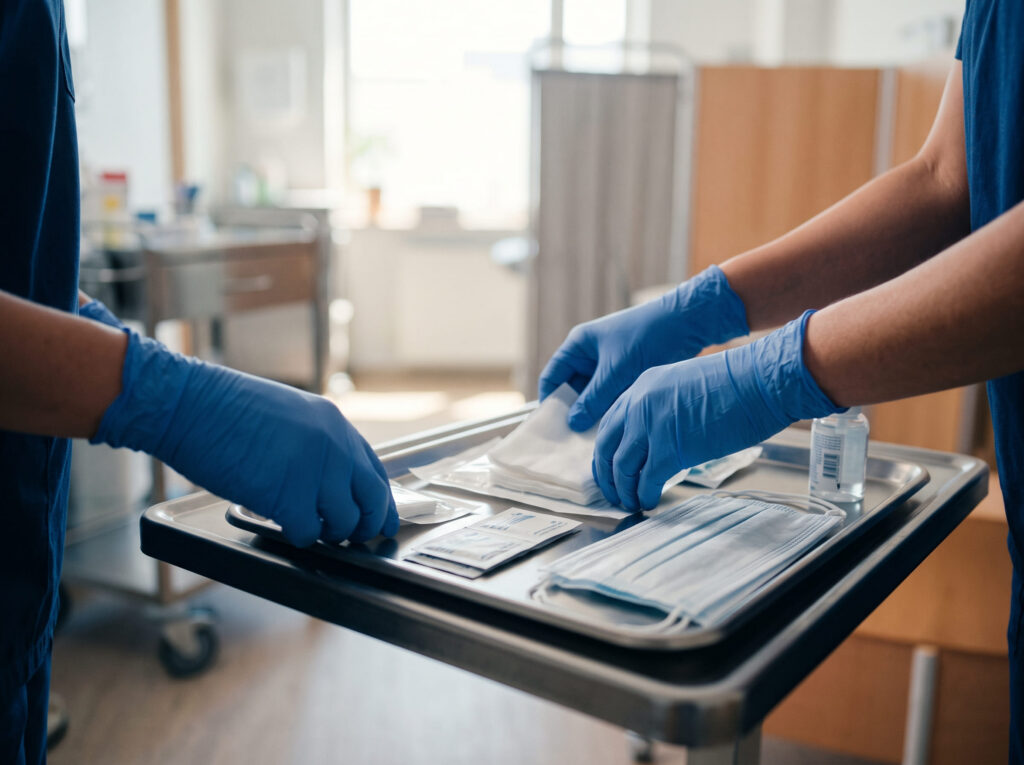
During the session, the two needles stay in place while your blood travels through the dialysis machine and back, and a nurse monitors you throughout. Once the track is established, insertion should feel much gentler than a standard sharp stick. Tell staff straight away if you feel burning, swelling or sharp pain at a needle site, since this can mean the needle has moved.
Right after needle removal, sites are held individually rather than together — typically two fingers per site — until bleeding stops. This keeps each puncture (there are two per site: one in the skin, one in the vessel wall) clotting cleanly into a small scab, instead of pooling blood into the track and forming a large, hard-to-remove clot. An antimicrobial ointment, most often mupirocin, is then applied to each site before it’s covered; many protocols have the dressing removed within about 24 hours, though your clinic’s exact timing may vary.
Not everyone who uses buttonhole cannulation will have a serious problem, but the complications below are real and can be severe. They are the reason the cleaning routine and a trained team matter so much, and why you should report changes early.
Contact your dialysis unit the same day if you notice redness, warmth, swelling or pus at a site, or a fever or chills, especially after a session.
New or severe symptoms require prompt medical advice. Do not wait for a routine appointment if you feel seriously unwell.
There is no recovery period in the usual sense: buttonhole cannulation is a needling technique, so you carry on with your normal dialysis routine. What matters is looking after the sites and letting the track mature.
Verified kidney centres linked to this treatment in the KidneyGlobal directory.


No. It only works with AV fistulas, not grafts, and your access needs a suitable straight, reachable segment. Thin tissue over the vein, an active skin infection or a fistula that has not fully matured are typical reasons to hold off, and your team will assess this individually.
Rope-ladder moves the needle placement along the length of the fistula and is the technique most guideline groups recommend as the default. Buttonhole reuses one exact pair of sites and is now seen as an option for specific situations rather than a routine substitute.
Setting up the track uses standard sharp needles, so those first sessions can be uncomfortable, and a numbing cream may be offered. Many people find a mature track gentler, but in one randomized trial pain scores did not differ significantly between the two techniques.
Usually 8 to 10 consecutive sessions, which is roughly three to four weeks on a three-times-weekly schedule. For upper-arm fistulas or slower wound healing it can take 12 to 18 sessions.
Yes, after training and approval from your care team. A guided track is part of why it is common in home hemodialysis, but strict hygiene and scab removal remain essential every time.
Tell your dialysis unit the same day you notice redness, pus, fever or a needle that will not go in. The usual plan is to treat any infection, stop using the buttonhole sites and return to rope-ladder cannulation, sometimes at a new site, before deciding whether to try again.