
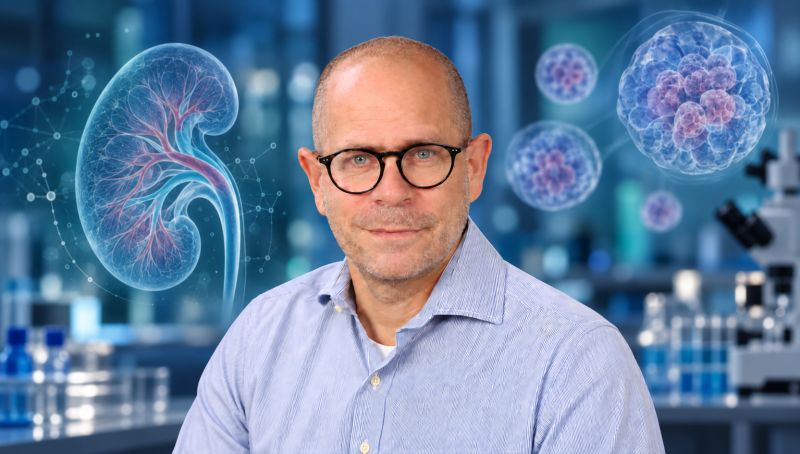
Prof. Benjamin (Benny) Dekel, a pediatric nephrologist and stem-cell scientist at Sheba Medical Center and Tel Aviv University, has been awarded the 2026 Kadar–Sheba Prize for Excellence in Research for his work on kidney development, regenerative nephrology and organoid biology. The research is still at the laboratory and early clinical stage. It is not a treatment you can ask for today, but it points to how kidney disease may be understood and repaired in the future.
What is the Kadar–Sheba Prize?
The Kadar–Sheba Prize for Excellence in Research is an annual award for physician-scientists in Israel who combine scientific achievement with real impact on medicine. It was created in 2021 by the Naomi Prawer Kadar Foundation and Sheba Medical Center. The foundation describes it as a US$100,000 award, made up of a US$75,000 research grant and a US$25,000 personal honorarium. Earlier recipients include Prof. Raz Somech (the inaugural winner), Prof. Lior Gepstein and Prof. Ohad Birk.
The 2026 prize committee praised both Prof. Dekel’s science and his work training the next generation of physician-scientists. It called him an outstanding role model for translational physician-researcher.
Who is Prof. Benjamin Dekel?
Prof. Dekel is a Full Professor of Pediatrics at the Gray School of Medicine, Tel Aviv University, and a former Vice Dean for Research Innovation and Development there. He is Chief of Pediatric Nephrology at the Edmond and Lily Safra Children’s Hospital at Sheba Medical Center and heads the Sagol Center for Regenerative Medicine at Tel Aviv University.
He trained in medicine at the Technion and completed his PhD and postdoctoral work at the Weizmann Institute of Science, and he has been a visiting professor at Stanford. His 2003 Nature Medicine paper on human and porcine early kidney precursors as a source for transplantation is among his most cited works. In short: he is both a children’s kidney doctor and a laboratory scientist, which is what „translational” research means in practice.
What did the award-winning research show?
For more than two decades, Prof. Dekel’s group has worked on one connected question: how do kidneys form, why does that process sometimes go wrong, and can it be harnessed to repair damage? The table below summarizes the main strands named in the prize announcement and his university profile, and where each stands for patients.
| Research strand | What the work showed | Where it stands for patients |
|---|---|---|
| Kidney tissue from early precursors | Embryonic kidney tissue can engraft and develop into mature renal tissue. | Laboratory research. Not an approved therapy. |
| Nephron progenitor cells | The lab isolated human nephron progenitor cells (the cells that build the kidney’s filtering units) and showed potential for tissue repair. | Laboratory research. |
| How the kidney repairs itself | Repair appears to depend on specific, lineage-restricted epithelial cell populations. | Basic science that guides future therapies. |
| Wilms tumor | The work reframed this childhood kidney cancer as a disease of nephron progenitor cells that stopped maturing, and identified pathways and possible drug targets. A cancer-stem-cell approach from his group helped prompt a multi-center trial in relapsing pediatric kidney cancer. | Reached clinical trial stage. Standard care should be discussed with a pediatric oncology team. |
| Organoids and secretome | The lab has built spheroids, renovascular units and human kidney organoids, and more recently KOSEC, a kidney-specific regenerative secretome made from organospheres grown from cells found in urine. | Early research and development. |
What does this mean for people living with kidney disease today?
For now, nothing changes in your care. The treatments for kidney failure remain hemodialysis, peritoneal dialysis and kidney transplant, alongside the long-term management of chronic kidney disease (CKD).
What the award does signal is direction. Understanding how a kidney is built helps explain congenital conditions such as renal dysplasia and childhood conditions such as pediatric nephrotic syndrome. It also helps explain cancers such as Wilms tumor. Organoids may eventually give researchers a way to test drugs on human kidney tissue before patients are involved. That is a hope grounded in current research, not a promise.
If you or your child has a kidney condition, the most useful step is a conversation with your nephrologist about whether any clinical trial is appropriate. Be cautious of any clinic that offers „stem cell kidney treatment” outside a registered trial.
What this news does not mean
- It is not a new treatment. A prize recognizes past achievement. It does not mean a therapy is approved.
- It does not mean kidneys can be regrown on demand. Most of the work described here is laboratory research.
- It does not replace dialysis or transplant for anyone who needs them today.
- It does not predict a timeline. Moving from laboratory findings to approved treatments often takes many years, and not every approach succeeds.
Sources
1. Benjamin Dekel (LinkedIn): “Humbled” post sharing the 2026 Kadar–Sheba Prize announcement from the Gray Faculty of Medical & Health Sciences
URL: https://www.linkedin.com/posts/benjamin-dekel-634687175_humbled-share-7512397723942150144-9KU3/
Note: Primary source for the award, the prize committee comment and the research summary. Accessed 23 Oct 2026. Page text was confirmed through public excerpts because the platform blocks automated access.
2. Tel Aviv University, Gray School of Medicine: Prof. Benjamin Dekel Awarded the 2026 Kadar–Sheba Prize for Excellence in Research
URL: https://en-med.tau.ac.il/school-of-medicine
Note: Confirms the award headline. Accessed 23 Oct 2026.
3. Naomi Prawer Kadar Foundation: News (Kadar–Sheba Prize background and past recipients)
URL: https://naomi.org/news/
Note: Prize founding year, award value and previous recipients. Accessed 23 Oct 2026.
4. Tel Aviv University: Prof. Benjamin Dekel, biography
URL: https://english.tau.ac.il/profile/dekelb
Note: Education, research focus and Wilms tumor trial background. Accessed 23 Oct 2026.
5. Namestnikov M, Pleniceanu O, Dekel B. Mixing Cells for Vascularized Kidney Regeneration (PubMed)
URL: https://pubmed.ncbi.nlm.nih.gov/34066487/
Note: Conflict-of-interest statement (KidneyCure Ltd). Accessed 23 Oct 2026.
6. Google Scholar profile: Benjamin Dekel (includes Dekel B et al., Nature Medicine 9(1), 2003)
URL: https://scholar.google.com/citations?user=G2n4v9cAAAAJ&hl=iw
Note: Publication record. Accessed 23 Oct 2026.